Greenhouse climate control all year round
We strive to maintain an ideal climate in our greenhouses throughout the year, one that closely matches optimal growth conditions for Phalaenopsis plants. By using artificial lighting, heating, ventilation, screening, humidification and dehumidification, we can control temperature, light and humidity.
To achieve this, extensive knowledge of seasonal climate variations is required. For instance, regulating conditions requires a completely different approach in winter than it does in summer. While this may seem obvious, understanding seasonal changes is critical for greenhouse climate control. This also applies to the transitional seasons, spring and autumn. With the widespread adoption of LED lighting, it is now more important than ever to apply our knowledge and insights effectively.
Energy balance
Energy balance is at the heart of greenhouse climate control. While energy enters the system through solar irradiation, artificial lighting and heating, it is also lost through radiation, ventilation (convection and air movement) and evaporation. The energy balance is the sum of energy input and energy loss. When the greenhouse temperature remains constant, incoming and outgoing energy are in equilibrium. An imbalance leads to temperature fluctuations until a new equilibrium is established.

Energy loss
The most significant difference between summer and winter is the level of energy loss through radiation. In addition to heat loss through the greenhouse walls and roof, the screens are cold, and this has a critical impact on plant temperature. Without sufficient energy input (such as artificial lighting or direct radiation from a heat source), plant temperature can quickly drop below room temperature.
Energy input
Energy sources vary throughout the seasons. In summer, the sun is the primary energy source, while in winter, pipe heating and lighting systems provide most of the energy, with solar irradiation being a negligible source during the darkest months. The amount of natural energy entering the greenhouse largely determines the difference between winter and spring or summer climates.
In December and January, the average outdoor irradiation is about 200 J/cm²/day, whereas in June it is about 2000 J/cm²/day — ten times as much! Pipe heating is by far the most important energy source in the greenhouse. However, lighting as a heat source is often underestimated. For instance, an average lighting system of 100 μmol/s/m² provides an energy input of about 50–55 W/m² when using SON-T
lighting and 25–30 W/m² when using full LED lighting. For comparison, in a 28°C Phalaenopsis greenhouse, pipe heating at 40°C with 16 pipes of Ø51 per 12.80 m bay has a heat output of about 28 W/m².
Plant temperature
Plant temperature vs greenhouse temperature
When talking about the climate in a greenhouse, we are usually referring to greenhouse temperature in combination with air humidity. However, plant temperature measurements are increasingly used in greenhouse climate control. And rightly so, as plant temperature largely determines all plant processes and, consequently, plant growth rate. Plant temperature primarily depends on room temperature, followed by net irradiation, which is ‘irradiation on the plant minus radiation from the plant’. Plant transpiration also affects plant temperature. When a leaf transpires heavily, its temperature is often lower than the ambient temperature.
Seasonal influences
Plant temperature fluctuations are particularly pronounced in the winter months. This is due to increased radiation from the colder screens, which, in combination with the on-off cycles of lighting systems, has a significant effect on plant temperature. In spring, sudden changes in solar irradiation can cause rapid increases or decreases in plant temperature.
Artificial lighting
Radiation in general and artificial lighting in particular have a considerable impact on climate and plant temperatures in a greenhouse. There are substantial differences between solar irradiation, SON-T lighting and LED lighting.
The table below illustrates these differences, based on standard conditions and assumptions:
· The light sum is set at 5.0 mol/m²/day for all seasons
· In winter, 90% of light comes from artificial lighting (4.5 mol/m²/day)
· In spring and autumn, 20% of light comes from artificial lighting (1.0 mol/m²/day)
· In summer, 100% of light comes from the sun
· All solar energy reaches the plant directly; for SON-T lighting, this is 90% (heat irradiation and light), and for LED lighting, it is 80% (heat irradiation and light)
Table: Energy at plant level at different times of the year with SON-T and LED
|
Light sum (mol/m²/day) |
Energy at plant level (J/cm²/day) |
Compared to 1 July |
|||||
|
Total |
From the sun |
Artificial lighting |
From the sun |
Artificial lighting |
Total |
||
|
1 Jan LED |
5.0 |
0.5 |
4.5 |
44.3 |
102.9 |
147.1 |
48 |
|
1 Jan SON-T |
5.0 |
0.5 |
4.5 |
44.3 |
218.9 |
263.2 |
86 |
|
1 Mar/1 Oct LED |
5.0 |
4.0 |
1.0 |
160.8 |
61.7 |
222.5 |
73 |
|
1 Mar/1 Oct SON-T |
5.0 |
4.0 |
1.0 |
160.8 |
131.4 |
292.1 |
96 |
|
15 May/25 July |
5.0 |
5.0 |
0.0 |
314.2 |
0.0 |
314.2 |
103 |
|
1 July |
5.0 |
5.0 |
0.0 |
305.6 |
0.0 |
305.6 |
100 |
We can see that the differences are quite significant, particularly with LED lighting, where the energy reaching the plants is relatively low — less than half compared to summer conditions and also considerably less than a SON-T installation. The graph below illustrates the above values. The X-axis represents the time of year; each point is a 10-day period in a month. The values are cumulative: for the LED and SON-T lines, it is the sum of sunlight and artificial lighting.
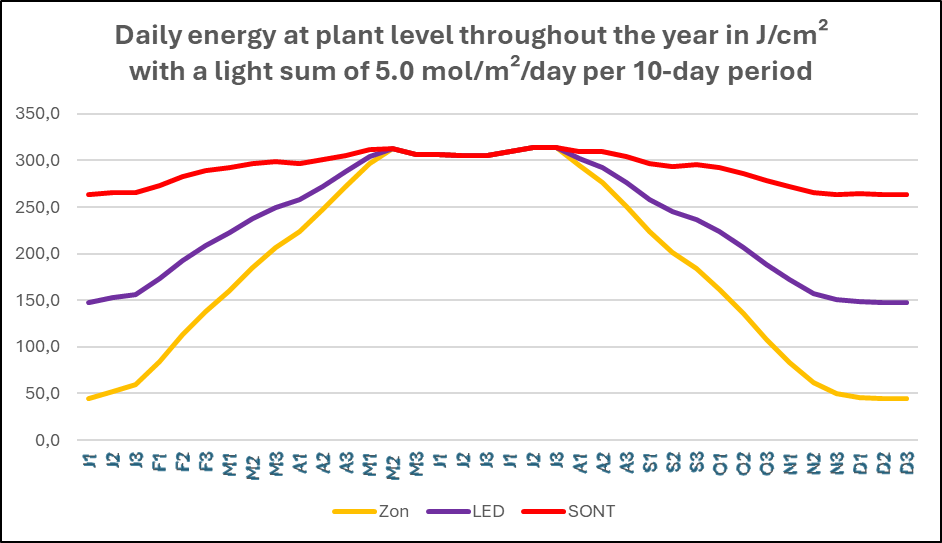
Graph: daily energy at plant level throughout the year.
Each point on the X-axis represents a 10‑day average. The months are divided into three parts. The LED and SON-T lines are the combined values of artificial lighting plus sunlight (the yellow line).
Practical application of this knowledge
When using LED lighting in winter, there is a significant energy deficit compared to using SON‑T or to summer conditions. This energy is required to maintain transpiration and plant temperature in the greenhouse. We therefore need to take various measures to bridge this gap.
Temperature
- Limit radiation loss by investing in a third screen and closing screens earlier.
- Adjust the use of lighting: extend lighting periods to better maintain plant temperature at specific times.
- Use heating systems more dynamically.
Screens
An increasing number of Phalaenopsis growers are installing a third screen in their greenhouses. Adding a screen improves insulation and reduces heat radiation from the greenhouse, preventing major energy loss. Closing the screens in the late afternoon, when net irradiation decreases, greatly prevents plant cooling. The drawback of using an extra screen and closing screens more frequently is that moisture removal is limited. Additional measures are therefore required to counter excess humidity.
Lighting and plant temperature
Artificial lighting primarily allows plants to produce more assimilates when there is insufficient sunlight. The lamps also help to raise the temperature of the plants. Although LED lamps can increase the temperature, the effect is greater with SON-T lamps. While excessive light can damage Phalaenopsis plants, it is important to realise that light damage is always caused by too much energy reaching the plant. This raises the plant temperature excessively, which leads to plant damage. However, artificial lighting can be intensified as long as it is desirable and not harmful in terms of plant temperature. In other words, do not hesitate to turn on the lamps for this purpose!
Heating
Last but not least is heating. This aspect is dealt with last because raising the temperature through the overhead heating system is the measure that requires the most energy and is not the most efficient way to directly transfer heat to plants. An intermediate heating system or 'hoist heating system', located between the plants and the overhead heating system and hanging 40 to 50 cm from the plants, can be effective though. Furthermore, an in-floor heating system can help raise substrate and plant temperatures. Overhead heating pipes have the least direct impact on plants. However, because the overhead heating system is suspended just below the screen, this can warm it up and appreciably reduce radiation towards the screen. This actually has a very positive effect on plant temperature.
Moisture/transpiration
- Active dehumidification (does not add extra energy but removes moisture from the greenhouse)
- Stimulating air movement
Active dehumidification
As the growing area is more closed due to the use of multiple screens, moisture is partially prevented from escaping and has to be removed by other means. This can be done by employing active dehumidifiers, which extract a lot of moisture from the greenhouse air using an energy input (electricity). The energy required for this is more than offset by the condensation of that moisture, and the surplus can be used again in the greenhouse for heating. It is a highly effective way of achieving optimal humidity levels.
Stimulating air movement
This is also referred to as passive dehumidification, where air movement removes moisture around the plant, thus making evaporation from plants and substrate easier. Because transpiration is stimulated, additional evaporative energy is required. This has to be compensated for with more pipe heating. As this further stimulates plant transpiration, extra attention should be paid to plant temperature, which may drop slightly because of an increased transpiration response. This is also the case with active dehumidification (mentioned above).
In conclusion, it is essential to understand how outdoor seasonal climate variations affect the warming and cooling of both greenhouses and plants. This allows us to anticipate and respond to changes with an array of tools. Growing under LED lighting poses even greater challenges, but recent developments, such as dehumidifiers and multiple screens, as well as fresh insights into greenhouse climate control, make it possible to grow healthy, vigorous plants even in winter.