Thrips in Anthurium
Worldwide, we are seeing a significant increase in thrips pressure in both cut flowers and pot Anthurium. In cut Anthurium, thrips can establish themselves in the crop and return every year to more or less the same places. This is often the case with thrips that are present on the leaves. White cultivars are generally attractive to western flower thrips. The degree to which certain leaf thrips can establish themselves is also strongly species-dependent.
Damage
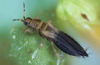
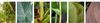
The damage of western flower thrips (Franklieniella occidentalis) can easily be recognized in the flowers as zigzag cork stripes (Photo 6) and sometimes egg craters (dark dots). Leaf damage on plants is sometimes difficult to distinguish from straw mite (Tyrophagus) damage (see Photo 1). Echinothrips (Echinothrips americanus) causes the well-known leafminer-like traces and silvery spots on the leaf Photo 2 . Anthurium (Chaetanaphothrips
Orchidii) and tobacco thrips (Thrips parvispinus) cause cork damage at the growth points (Photo 3). Another characteristic of these thrips is that they inhibit crop growth. Tobacco thrips eats the flower and leaf stalk and are therefore easy to recognize (Photo 4). Palm thrips (Parthenothrips dracaenae) cause brown discoloration of the leaves which looks like red spider damage (Photo 5).
Biological approach
An airobug from Koppert Biological Systems that ensures an automatic, fast and constant spread of natural enemies.
In the case of western flower thrips and onion thrips (Thrips tabaci), successful control is possible with the predatory mite Amblyseius swirski. This leaf predator mite feeds on young thrips larvae. The Swirski-Mite LD bag is the preferred option, provided that irrigation takes place underneath and the plants touch each other. In situations with overhead watering, it is advisable to sprinkle or blow Swirski-Mite. We also support the predatory mite population with extra food by blowing Predafeed. Predafeed, based on the feed mite Carpoglyphus lactis, has been extensively tested and found safe for Anthurium.

To fight the pupae of western flower thrips and onion thrips, the introduction of the soil predatory mite Macro-Mite is recommended at the beginning of the cultivation. In cut Anthurium, we recommend the introduction of a soil predatory mite four times a year as a maintenance operation. Also in pot Anthurium we see a tendency to introduce Macro-Mite again when the plants are spaced. Predatory mite products are grown and supplied with feed mites. In exceptional cases, the feed mite Tyrophagus can cause damage to Anthurium crops. A major advantage of both Swirksi-Mite and Macro-Mite is that they are supplied with our crop-safe feed mite, Carpoglyphus lactis.
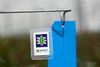
To attract adult thrips to sticky traps, a Lurem-TR dispenser can be hung near the sticky trap to attract more thrips and give you a quicker picture of the thrips population on the farm. Western flower and onion thrips, in particular, are easily caught on these sticky traps. Less mobile thrips species can be scouted in the crop by shaking the plants above a sheet of paper and observing crop damage at an early stage.
To support basic biological controls with soil and leaf predators in the event of increasing thrips pressure or in sensitive cultivars, a corrective treatment with Entonem nematodes (Steinernema feltiae) is recommended for pot culture. These nematodes are most effective against the pupal stage of thrips.
Neither Echinothrips or Anthurium thrips are very mobile and therefore do not get caught easily on sticky traps. Biological control of these thrips species is challenging for several reasons.
New on the scene are Thrips nigropilosus (chrysanthemum thrips) and Thrips parvispinus. Our focus is on these newly-identified thrips species and we are looking for effective biological solutions.
Practical trials with Orius laevigatus show hopeful results. When using this assassin bug, we make use of a supplementary feeding system.
A general deployment schedule can look like this:
| Swirski LD grow bag | Replace 1 bag/2m2 after 6 weeks |
| Swirski-Mite tube | 50-100/m2 interval 1 to 2 weeks |
| Predafeed feed mite | 2000/m2/week |
| Macro-Mite soil predatory mite | 250/m2 |
| Entonem nematodes | 500,000/m2 |

The paper on biological control in this article was written with the help of Wim van der Meer and Marjolein van der Knaap-Stolk, consultants in floriculture at Koppert Biological Systems.