Physiological abnormalities
Just as people can fall ill, Phalaenopsis may display abnormalities or become diseased during growth and development. This section addresses abnormalities not caused by insects, fungi or bacterial pathogens but rather by other external factors. These are often related to greenhouse climate conditions such as: temperature, light and humidity.

The plants can also be harmed by factors resulting from suboptimal greenhouse climate conditions. This might include mechanical damage (for example, when a young leaf remains stuck in the sheath), a deficiency or excess of one or more nutrients or harmful substances in the air such as ethylene. Crop protection products can also cause damage or abnormalities to flowers or leaves.
General
Generally, a plant (or a part of a plant, such as a leaf) has mechanisms to protect itself in challenging conditions, including very high or low temperatures or intense light. For instance, anthocyanin may develop in the leaf, enhancing the plant’s resilience to these conditions. This leads to changes in appearance—such as reddening of foliage—and is just one example of a plant adaptation that, in itself, need not be detrimental but which we nevertheless consider to be a compromise on quality.
In Phalaenopsis cultivation, we can distinguish between vegetative abnormalities (in the leaves) and generative abnormalities (in the stems and flowers). In this month’s newsletter, we discuss a number of generative abnormalities.
Abnormalities in flower and stem
Crooked stems:
Flower stems are supposed to grow straight upwards. Sometimes, however, a distinct bend develops—usually at a node or bud site—and the stem continues growing at a sharp angle. The precise mechanism is not fully known, but several circumstances can increase the prevalence of this abnormality:
- Sensitive variety
- Use of flowering hormones (BAP or other cytokinin plant hormones)
- Dry or harsh growing conditions: crooked stems are notably more common in spring than in other seasons— sudden bright light combined with low relative humidity during the first airing is often the cause
- Low temperatures during the stem development phase
For sensitive varieties, avoid flowering hormones such as BAP and keep the nursery humidity at a slightly higher level in early spring. Aim for a minimum daily temperature of 21.0°C during the finishing phase.

Blind stems:
Sometimes, a plant initiates stem growth, but these stems develop with no bud formation. On the surface, these ‘blind stems’ seem to be the result of a shortage of assimilates, causing buds to fall off. However, there’s more to it than that: buds fail to develop at all. We observe this phenomenon in low-light conditions combined with temperatures that are too low. Low temperatures halt the energy-intensive processes that are vital to healthy development. This is likely linked to enzyme synthesis and breakdown rather than energy balance disruption.
Brittle stems:
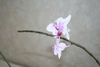
Stems are normally somewhat flexible. In brittle stems, however, they are very rigid and can break with minimal external pressure. Sometimes, stems may break during growth (see photo). The pressure from sap flow in the stem (turgor) and stretching can cause the stem to split open or even break off completely. This can be due to calcium deficiency that affects plants with vigorous stem growth (for example, large-flowered varieties). Calcium is essential for cell wall strength as it acts like ‘cement between the cells’. Another cause of brittle stems is excess nitrogen during the finishing phase. This results in rapid cell growth and leaves the cell with insufficient time to reinforce its walls with cellulose or lignin. While this growth makes stems appear thick and strong, they break easily.