No bug escapes Clarice Hughes
She is an indispensable link in effective crop protection. Over her six years at Anthura, Clarice Hughes has specialized in scouting insects and fungi. Armed with her standard gear: a backpack with a magnifying glass, a stack of notebooks, and a headset, Clarice spends her days among the plants. Always on the lookout for anything that crawls, flies, and above all does not belong among the crops.
To learn more about this unique specialization and what it means for more sustainable cultivation, we sat down with Clarice for a conversation.
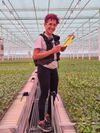
Can you briefly introduce yourself?
I was born and raised in Brazil, but moved to Portugal when my mother decided to look for a safer life. I had a great time in Portugal, but at a certain point I felt I wanted more. In the Netherlands, I was able to take a Dutch language course at TU Delft. It was supposed to last only three months, but I fell in love with the culture, and by now I’ve been learning Dutch here for ten years.
What is your role at Anthura?
I started at Anthura in 2020. Before that, I worked in a restaurant, but because of the COVID pandemic I had to do something else. That was quite challenging, also because at the time I could hardly practice my Dutch.
Because I’m crazy about plants, I really wanted to do something in horticulture. I started at Anthura in the pot plant department, and there my love for the plants only grew further. In 2023, I started scouting, because I quickly noticed when something was wrong with a plant.
What do you enjoy most about your work?
I love putting on my headphones and walking among the plants all day. Our department mainly focuses on the health of the plants, what they need, whether they’re too cold or too warm, or if they’re getting enough light. Everyone here has their own role, but the end result is always the same: delivering high-quality plants. That’s why we’re always there for each other, like one big family.
You’re known for your sharp eye for insects and biological crop protection. How did this interest develop?
From a young age, I’ve always loved plants. My interest only grew stronger when I learned to speak the plants’ “language”: the subtle signals they give when they need something. If I can’t figure something out, I ask experts. That way, I keep learning every day. So I’m not only studying Dutch, but also the language of plants.
What exactly does insect scouting involve in cultivation, and why is it so important?
We always want to see beautiful, healthy plants. Still, it sometimes happens that a plant shows abnormalities, such as yellow leaves, spots, or differences in leaf size. In those cases, I really just need to listen to the plant, it tells me exactly what it needs. Then it’s a matter of deploying the right insects.
For example, if there are aphids, I introduce an insect that feeds on aphids. I then continue to monitor the plants closely to see whether all the aphids are gone or if additional biological control is needed. This prevents an infestation from spreading and keeps the plants healthy.
Which natural control agents do you work with most, and how do you determine the strategy?
Each biological control agent has its own function. For plants with aphids, I use Chrysoperla carnea to feed on the aphids. These plants have previously been visited by Aphidoletes and parasitic wasps, which enter the greenhouse weekly for preventive protection.
Against thrips, I work with several control agents: Orius for the adult insects, Montdorensis for the larvae, and Robustulus for the pupae. Anthura also uses machines that distribute insects throughout the greenhouse, which greatly strengthens preventive protection.
I like the fact that the insects are very predictable. They always do exactly what I expect them to do. It’s the most natural way to care for plants. That’s how we work with healthy methods for healthy plants.
What trends and/or challenges do you see for the future of more sustainable cultivation?
I’m curious to see what additional benefits the arrival of drones and AI will bring to biological crop protection in the coming years. We’re also about to start testing drones ourselves to help with scouting. The drone alerts me as soon as something deviates in a plant, allowing me to work even faster and more accurately. When deploying biological control agents, speed is essential, and drones make that possible. In this way, we improve the quality of our cultivation and prevent pests from spreading.
Do you think biological control agents can replace conventional crop protection products?
I hope so, although it will probably take a few more years. So far this year, we’ve worked exclusively with biological treatments, and that makes me hopeful. If we continue on this path together, I expect biological control agents to gain more and more ground within the sector.