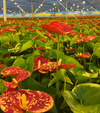
Anthurium abnormalities (part 2)
In this second part on growth disorders in Anthurium, we continue by discussing a number of physiological phenomena that regularly occur in practice in Anthurium cultivation. These disorders often have a clear relationship with climate, nutrition, and crop handling, and can vary significantly by cultivar and growing conditions. By understanding the causes well, it is often possible to anticipate them in a targeted way.

Slow Ripening
When the flower temperature is low, the ripening of the spadices proceeds slowly. The white section at the base of the spadix only appears after the spathe has unfolded. Faster ripening can be achieved by closing the screen earlier, using supplemental lighting, and applying top heating.
Yellow Spadices
This phenomenon occurs mainly under summer conditions when the relative humidity is too low (<60%). Older crops and crops with poorer root conditions are especially susceptible. Cultivar sensitivity also plays a role.
Prevent yellow spadices by ensuring optimal climate conditions. Timely harvesting of flowers is also important. In summer, harvesting every two weeks may even be necessary.

Blue Discoloration and Glassiness
Under certain conditions, blue discoloration occurs in red and orange cultivars. Glassiness occurs in white cultivars. There is a strong degree of cultivar sensitivity to this phenomenon.
Nutrition
An especially low level of calcium incorporated into the spathes intensifies the problem. Ensure a K:Ca application ratio of 1.2–1.3 : 1. With an excessively high potassium application, the crop absorbs less calcium.
A low pH (<5.5) and low EC (cutting crop: starting EC 1.3–1.4 mS/cm; squeeze sample and pot crop: <0.4–0.5 mS/cm at a 1:1.5 analysis) further exacerbate the phenomenon.



Internode Elongation
Anthurium naturally has the ability to grow towards the light by elongating the internodes. There is a strong degree of cultivar sensitivity involved. This phenomenon is undesirable for plant structure and anchorage in the substrate (potted Anthurium) and leads to upward crop growth and rapid ageing (cut Anthurium).
Planting too deeply, causing (part of) the growing point to be in darkness, gives the plant an impulse to grow upward. A humid microclimate with stagnant air and high relative humidity further enhances internode elongation. A low EC and high nitrogen supply also promote elongation. The internode responds slowly after a certain (climate) action. After winter, under low-light conditions (Europe), internode elongation is most severe in April/May, following the darkest days.
Cut Anthurium
An overly dense leaf canopy causes internode elongation, as the crop searches for light. Removing young leaves and halving leaves allows more light into the crop, resulting in shorter internodes.

Leaf and Flower Stem Elongation
During the period of decreasing day length (from mid-September in Europe), there is a higher risk of elongation of leaf and flower stems. In plants that are artificially lit, this elongation is often greater than in plants without lighting.
The first signs of elongation become visible as the sun’s position lowers, solar radiation decreases, average plant temperature drops, and more heating is applied via floor or sub-pipe systems. These are some of the factors influencing elongation. In addition, other factors may play a role, such as changes in the light spectrum (more red than far-red light), shortening of the daylight period, and higher humidity in the microclimate.
The exact cause of elongation of flower and leaf stems has not yet been fully determined. The assumption is that insufficient transpiration in combination with high root pressure causes excessive cell turgor.
Due to falling outdoor temperatures, more heating is applied, especially via floor or sub-pipe heating. The difference between root temperature and plant temperature increases. Differences of more than 2°C between root and plant temperature are often measured.
With supplemental lighting, this elongation is further intensified. Due to lighting, the upper leaves warm up more, activating the plant. Transpiration starts, but root pressure also increases. The plant attempts to transport absorbed water to the leaves, while the lower leaves in the plant remain cold. As a result, transpiration occurs, but it is insufficient in relation to the root pressure.
When the flower bud is positioned horizontally, the flower stem no longer continues to elongate.

Measures to help reduce elongation:
- Ensure good air movement in the lower part of the crop so the entire plant can transpire properly. Air movement created by heating via sub-pipes or floor heating alone is not sufficient;
- Timely spacing of the plants is necessary. Ideally (if possible), space the plants an extra time with smaller differences in plant distance;
- Practical experience shows that maintaining a higher night temperature than day temperature can also help prevent elongation;
- Ensure that, before the lamps are switched on in the morning, the greenhouse temperature is lowered by 1°C (with LED lighting), so that crop warming occurs more slowly. When using SON-T lighting, lower the greenhouse temperature by 1.5–2°C.